

Married but No Wedding
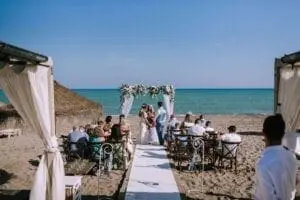
Many couples during the pandemic have found themselves in the position of being able to contract their legal marriage but unable to celebrate it with family and friends. Up until now, newlyweds may have been deprived of the wedding ceremony that they dreamed of. Meet the ‘married but no wedding’ couples and learn how they can still have the wedding ceremony of their dreams.
Is a symbolic wedding a REAL wedding?
A symbolic wedding on a different day to the day you get married is not a fake ceremony it is 100% your real wedding day. This is because a ‘marriage’ and a ‘wedding’ are two different things. ‘Marriage’ is a legally binding agreement between two parties; a ‘wedding’ is a ceremonial celebration reflecting the beliefs and customs of the two people getting married.
You can have a marriage without a wedding and be legally married, like during the pandemic.
You can have a wedding without a marriage but it is important to note that you will not be legally married, this is just the celebration part.
The most common way of doing things is to have a marriage and a wedding on the same day at the same time.
Traditionally couples include contracting their legal marriage with some kind of wedding ceremony.
If you prefer, you can have your marriage and your wedding on different days or even in different countries like a ‘destination wedding’ abroad.
A marriage and a wedding are different
Simply put, a marriage is a legal contract. At its most basic it can consist of 40 words plus your names and a formal entry to a UK marriage register.
Saying your vows is not part of the marriage contract. Readings are not part of the marriage contract. A ring exchange is not part of the marriage contract. Rituals and other traditions are not part of the marriage contract. All of these ceremonial elements around contracting your marriage is the wedding. That’s the fun part!
Different types of wedding
You can have different types of wedding ceremony:
A religious ceremony
A civil, secular or non-religious ceremony
A blended faith ceremony where you and your partner are from two different belief systems and you respectfully represent both faiths
There are even different names for the ceremonial elements of celebrating your marriage, which include renewing your commitment of marriage to each other a while after you are first married. These include a Symbolic Wedding, a Wedding Blessing, a Marriage Blessing, an Affirmation of Vows and a Vow Renewal Ceremony.
What is the difference between a religious and non-religious wedding?
So if the marriage is the legal contract, now we understand that the wedding is the ceremonial celebration… and that ceremonial aspect can be religious or non-religious. It is the ceremonial aspect that allows you to personalise your ceremony and enhance it with other elements that reflect your beliefs or your personalities.
A religious wedding ceremony may be held in a place of worship such as a church, mosque or synagogue. This will be officiated by a religious minister and include elements such as prayers, religious readings, the giving and receiving of rings and other traditional or cultural elements particular to your faith.
Note that not all religious ministers are authorised to contract your legal marriage and so you may still need to register this with the authorities.
A non-religious wedding ceremony may be officiated by your registrar at the same time as contracting your legal marriage in the register office or at an approved premises. A Humanist celebrant can provide an alternative to religious ceremonies, or an independent celebrant who can include some religious elements . They may also blend elements from your two different religions to represent both families in a bespoke ceremony written especially for you.
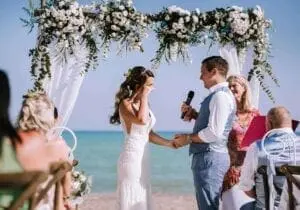
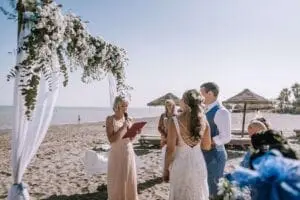
A celebrant-led ceremony may be held wherever you like eg on the beach, at a private venue, in a hotel, up a mountain or pretty much anywhere. These may include ceremonial elements such as saying personal vows, readings that reflect your personalities, exchanging rings, rituals and symbolic traditions from other cultures such as handfasting to tie the knot, sand ceremony to unify two families, or the red thread of destiny to connect two souls for all time. (Some registrars now also offer ritual elements to their ceremonies)
Destination wedding ceremonies
So once you understand that you can separate your marriage from your wedding, it is easy to see how a destination wedding in another country works. Destination weddings fall into two categories: get married overseas in combination with your wedding, get married at home then have the wedding overseas
If contracting your legal marriage abroad and having a destination wedding at the same time, remember to triple check that you take the required documents with you. All documents must be within the required date and they may need to be translated into the foreign language. Your new foreign wedding certificate may also need to be translated back into English! A good point to note is that it is easier to order additional copies of your wedding certificate at the time of getting married.
If you are contracting your marriage in your home country and then travelling abroad to enjoy a destination wedding ceremony in the sunshine, you can be confident of understanding the legal marriage process as it is in your own language. You don’t need to translate any documents and you can easily order additional copies of your wedding certificate in the future if needed. Your marriage is easily traceable for future generations researching genealogy and you can travel to your overseas wedding stress free – knowing you are already legally married!
Enjoy the different wedding options
So whether you never had the wedding that you dreamed of and want to celebrate with your family and friends at home, or want to fly off to a destination wedding somewhere overseas, you can do so knowing that your wedding day IS YOUR REAL WEDDING!
Author: Debbie Skyrme is ‘Celebrant Spain’. Debbie is a former UK registrar and an award winning independent celebrant. Helping couples by officiating bilingual elopement, vow renewal and wedding ceremonies in the Spanish sunshine.
Photo credit: photographybynatasha.co.uk