


Buying the Perfect Engagement Ring – The Ultimate Guide
Since 2000, on average around 300,000 weddings have taken place in the UK every year. But, due to coronavirus-related restrictions, 2020 looks set to be different.
However, during lockdown, love has still been in the air. After all, lockdown has meant many of us have been able to spend much more time with our loved ones, and many of us have realised we’ve been living with ‘the one’ this whole time.
So, if lockdown has made you realise that your significant other really is ‘the one’, how can you propose and ensure that lockdown is a memorable moment for all the right reasons? Let’s take a look at how you can locate the perfect engagement ring during the lockdown period, so you can still pop the question.
Searching for Online Inspiration
Although you can’t visit your favourite jeweller in person, many jewellers are still operating online, so it’s possible to get the ring of your significant other’s dreams delivered to your door. However, a jeweller’s website may not be the best place to search for inspiration because you’re met with so many options, and you may not be able to see how the ring looks on a finger.
So instead, to narrow down your search, take to Instagram, which is the go-to place for celebrity engagement announcements and ring inspiration. Everyone from Kim Kardashian to Lady Gaga has announced their engagement on Instagram, but the platform is just as popular with everyday couples looking to announce their engagement to their friends and loved ones. In fact, almost 13,500,000 Instagram posts include the hashtag #engaged.
Although many of these posts include beaming pictures of the happy couple, most also include close up photos of the ring on the finger, so you can get a great idea of what certain styles and shapes actually look like.
Once you’ve seen a certain style that you like, you can even use Instagram to narrow down your search for the shape of the stone to something like #ovaldiamond (63,000 posts) or #pearshapeddiamond (31,500 posts).
Choosing Your Engagement Ring: Know ‘the 4 Cs’
Once you have an idea of which style of engagement ring you’d like to buy, you’ll need to decide on which stone (or stones) you’d like for the ring of your partner-to-be.
Most engagement rings contain a diamond, but coloured stones have been made popular by celebrities such as Katy Perry and Kate Middleton, who chose ruby and sapphire rings respectively.
Similarly, some people choose the central stone that matches their partner’s birthstone, while others choose a stone that matches their partner’s favourite colour. There’s no doubt that buying an engagement ring is a deeply personal choice, and you should select a stone that matches your personality and preferences. Remember, there’s no traditional ‘right’ or ‘wrong’ answer: just choose something that comes from the heart.
However, there are some things you should consider when selecting a stone; particularly a diamond. If you choose a diamond (as around 85% of people do), then you need to get to know what jewellers call ‘the 4 Cs’: colour, cut, carat and clarity.
Each diamond should come with a certificate that explains how it scores in relation to these categories. Ask your jeweller to see it so that you can make an informed buying choice.
Colour
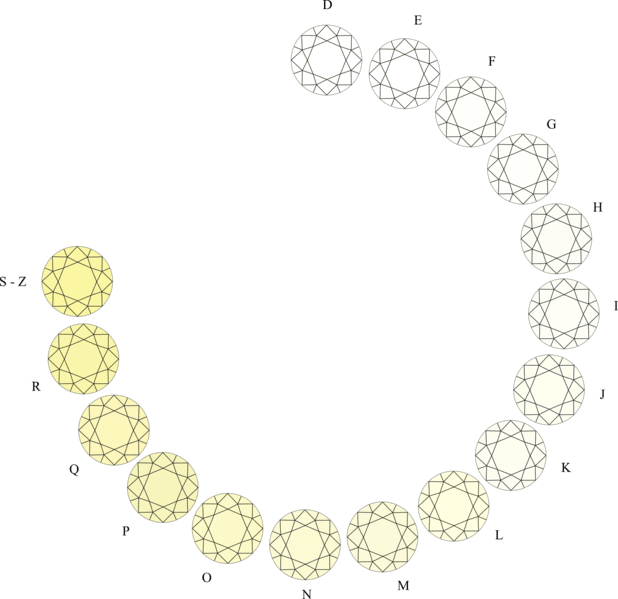
Image Credit: Creative Commons
Diamonds are colour graded between D and Z, but white diamonds are usually graded between D and J.
A diamond graded D will be colourless and exceptionally white, while a J-rated diamond will be slightly tinted or potentially pale yellow. The higher a diamond scores on the scale (the closer to D), the more expensive it will generally be.
If you want to avoid a diamond that has a yellow-ish tone, then you’ll ideally want to choose a diamond that is rated H or higher.
Cut
Once you’ve found a stone you like, the next step is to decide on the cut. Some jewellers believe that this is the most important of ‘the 4 Cs’ because the cut will have a large effect on the sparkle of the stone.
As ring shoppers, we believe that the cut of the stone relates to its shape. For example, some may be round, heart-shaped, or pear. But, for a jeweller, the cut relates to how the diamond reacts with light. Even if your stone is perfectly clear, if it has a poor cut then it will appear dull. For this reason, the cut of a diamond is graded from poor (the worst cut) to excellent (the best possible grade).
Carat
When you’re thinking about purchasing an engagement ring, you’re probably thinking about the size of the stone in the middle. However, jewellers don’t really measure the size of the stone. Instead, they measure the carat size, which is actually the stone’s weight. The larger the carat size, the heavier the stone.
But, the old adage ‘size isn’t everything’ weighs true here. For example, a high-carat diamond with a poor cut may actually look a lot smaller that a small diamond with a better cut.
For a little bit of guidance, the average carat size for an engagement ring in the UK is 0.6 carats, but this includes all diamonds in the ring, not just the central stone. Remember, the weight of all those little stones embedded in the band could add up!
Clarity
Although most diamonds seem dazzling and sparkly to the naked eye, almost all diamonds contain small imperfections.
The clarity of the diamond is measured by how many of these small imperfections, exclusions and blemishes exist inside the stone. A flawless diamond (FL) is the clearest diamond, and then the scale includes internally flawless (IF), very, very slightly included (VVS), very slightly included (VS) and slightly included (SI).
Of ‘the 4 Cs’, clarity is the factor that many people consider the least when making their purchase. This is because, to the untrained eye, these imperfections aren’t visible.
Choosing a Band: Which Metal is best?

Image Credit: Unsplash
Choosing the stone for the ring is the subject that most people spend hours agonising over. But, even when you decided on the type of stone you’d like and the shape, you also need to decide which precious metal you’d like for the band.
You may find that your partner prefers a specific colour (such as silver or gold), or they may prefer a specific metal (such as gold, white gold or platinum). One of the best ways you can decide which metal they might like best is to look at their current jewellery for clues. If they wear a lot of yellow jewellery, then opt for a traditional gold. But, if they wear a lot of jewellery with a pink-ish hue, then rose gold may be a better choice. If they wear silver or white jewellery, then you can choose between platinum and white gold.
Remember that each metal also has its own characteristics. Platinum engagement rings, for example, are corrosion resistant and highly durable, but this makes it very expensive. On the other hand, white gold is cheaper than platinum, but it will also require more maintenance, so it may end up being more expensive over time.
If you’re looking at gold, you need to consider its purity, which is measured in carats (this is different to the carat system that measures diamond weight). This will be displayed by a number (usually between 9 and 24), followed by a symbol like ct, K or kt. The lower the number, the more other materials are mixed in with the gold to create an alloy, which strengthens the gold:
- 9-carat gold = 37.5% pure gold
- 14-carat gold = 58.5% pure gold
- 18-carat gold = 75% pure gold
- 22-carat gold = 91.6% pure gold
- 24-carat gold = 99.9% pure gold or higher
Generally, 22-carat gold and 24-carat gold are not considered to be appropriate for stone settings, because they’re so malleable. Instead, 18-carat gold and 14-carat gold are more common settings for engagement rings. However, 9-carat gold engagement rings are also available, and these are usually the cheapest option.
How do I Find Out My Partner’s Ring Size?
Once you’ve chosen the perfect engagement ring for your partner, you need to make sure you order the correct size for the ring. However, if you’re buying your ring online because you can’t reach the store, you may find it difficult to measure your partner’s ring size without a professional measuring tool. Most jewellers would recommend visiting a local jeweller for a definitive size – maybe you could take in one of your partners existing rings. In most cases, rings can be resized. However, you should be aware that, depending on the stone of choice and the setting, there might be limitations. This is because any changes to sizing will change the curvature of the band, and this may affect the setting style.
Final Thoughts
Although you may not be able to visit a jewellery store in person to select an engagement ring, there’s nothing stopping you from finding the ring of your partner’s dreams at home.
So, head to Instagram for some #inspo and get started on your research. Remember ‘the 4 Cs’ carefully if you’re searching for a diamond and ensure that you stick to your budget. Yes, ideally everyone would love a HUGE diamond that’s perfectly clear, but this may not be affordable for you, so consider which of ‘the 4Cs’ matters the most and use this to guide your decision. Then, select your band and get measuring.
Once you’ve picked the perfect ring, all you have to do is find a romantic way to pop the question. Good luck!
Many thanks to Andre at Spike Digital for this article
See our recommended jewellers here
